Introduction
When your business starts growing, one big question comes up:
Should you hire an in-house employee or a virtual assistant?
At first glance, hiring full-time staff might seem like the traditional and reliable choice. But in 2026, businesses are shifting toward smarter, more flexible solutions.
A virtual assistant (VA) offers a modern alternative that can reduce costs, increase efficiency, and deliver strong returns on investment.
In this guide, you’ll get a clear, side-by-side comparison to help you decide what’s best for your business.
What Is a Virtual Assistant vs In-House Employee?
Virtual Assistant (VA)
A virtual assistant is a remote professional who provides services like:
- Administrative support
- Marketing assistance
- Customer service
- Data management
They typically work on a contract or hourly basis.
In-House Employee
An in-house employee is a full-time or part-time staff member who:
- Works from your office (or remotely full-time)
- Receives a fixed salary
- Is part of your internal team
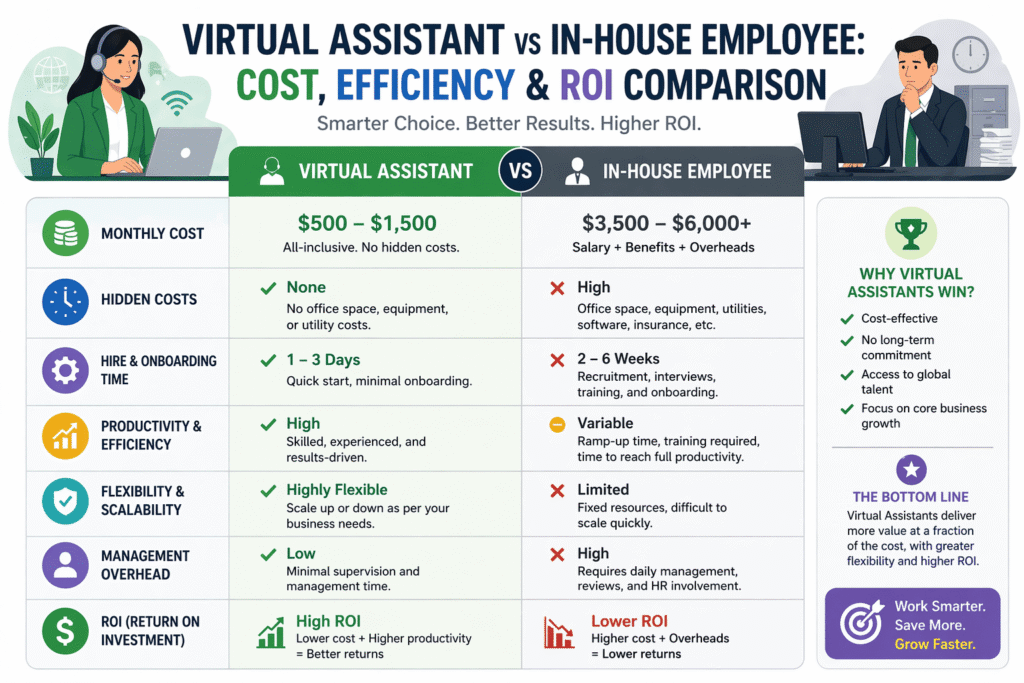
Cost Comparison: Which Is More Affordable?
Hiring an In-House Employee Costs Include:
- Salary (fixed monthly expense)
- Office space and equipment
- Employee benefits (insurance, bonuses, paid leave)
- Training and onboarding
These costs add up quickly.
Hiring a Virtual Assistant Costs Include:
- Hourly or project-based payment
- No infrastructure costs
- No employee benefits
- Minimal training required
👉 Result: Virtual assistants are significantly more cost-effective, especially for small businesses and startups.
Efficiency Comparison
In-House Employee Efficiency
- Fixed working hours
- May handle multiple roles
- Can be less productive during slow periods
Virtual Assistant Efficiency
- Works only on assigned tasks
- Highly specialized skills
- Focused and output-driven
👉 Result: Virtual assistants often deliver higher productivity because you pay for results, not time.
Flexibility & Scalability
In-House Employees
- Difficult to scale quickly
- Long hiring process
- Fixed workload
Virtual Assistants
- Easily scale up or down
- Hire multiple VAs for different tasks
- No long-term commitment
👉 Result: VAs provide unmatched flexibility for growing businesses.
Skillset & Expertise
In-House Employees
- Limited to their job role
- May require training
- Skill upgrades take time
Virtual Assistants
- Specialized in specific areas
- Already trained
- Access to global talent
👉 Result: VAs bring diverse expertise without additional training costs.
Control & Communication
In-House Employees
- Direct supervision
- Face-to-face interaction
- Easier team integration
Virtual Assistants
- Remote communication
- Requires clear instructions
- Uses tools like Slack, Zoom, Trello
👉 Result: In-house employees offer more direct control, but VAs can be equally effective with proper systems.
ROI (Return on Investment)
In-House Employee ROI
- Higher upfront investment
- Slower ROI due to overhead costs
Virtual Assistant ROI
- Lower initial investment
- Faster returns
- Pay only for productive work
👉 Result: Virtual assistants typically deliver a higher ROI, especially for small and medium businesses.
When Should You Choose a Virtual Assistant?
A virtual assistant is ideal if:
- You want to reduce costs
- You need flexible support
- You’re outsourcing repetitive or specialized tasks
- You want to scale quickly
When Should You Choose an In-House Employee?
An in-house employee makes sense if:
- You need full-time, long-term support
- The role requires constant supervision
- You’re building a core internal team
Hybrid Approach: The Smart Strategy
Many successful businesses use a combination of both.
For example:
- Core team → In-house employees
- Support tasks → Virtual assistants
This gives you:
- Stability + flexibility
- Control + scalability
Why Businesses Are Switching to Virtual Assistants in 2026
Modern businesses prioritize:
- Cost efficiency
- Remote work flexibility
- Faster scaling
That’s why virtual assistants are becoming the preferred choice.
Why Choose Virtual Eases?
If you’re considering hiring a virtual assistant, the right partner makes all the difference.
With Virtual Eases, you get:
- Experienced professionals
- Flexible pricing models
- Reliable and secure services
- Support across multiple business functions
Whether you need admin help, marketing support, or lead generation, Virtual Eases delivers results.
Conclusion
There’s no one-size-fits-all answer—but for most businesses today, virtual assistants offer a smarter, more scalable solution.
If your goal is to:
- Reduce costs
- Increase efficiency
- Grow faster
Then hiring a virtual assistant is a strategic move.
FAQs
1. Is a virtual assistant better than an employee?
It depends on your needs, but VAs are more cost-effective and flexible.
2. Can a VA replace a full-time employee?
For many tasks, yes—especially administrative and support roles.
3. Are virtual assistants reliable?
Yes, especially when hired through trusted providers.
4. What is the biggest advantage of a VA?
Lower cost with higher flexibility and scalability.