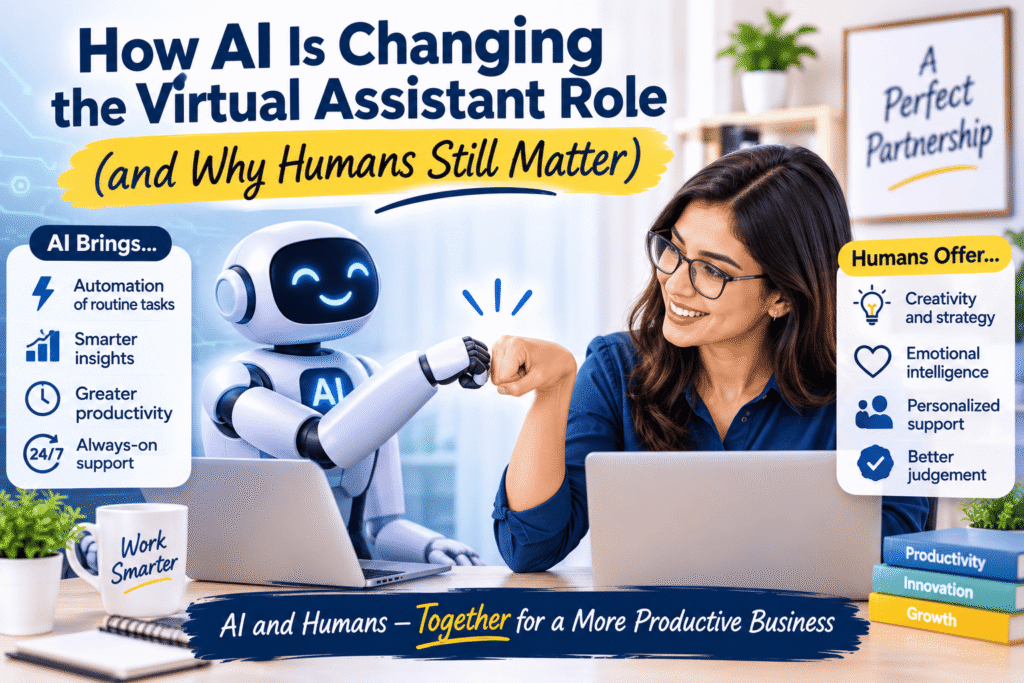
AI is changing the virtual assistant role by automating repetitive tasks such as drafting, summarising, transcribing and scheduling. It is unlikely to replace human virtual assistants, because people provide judgment, context, accountability and trust. The strongest results come from a human VA who uses AI tools well.
A few years ago, a virtual assistant’s day was full of manual work: sorting emails, typing up notes, formatting documents and copying data between tools. Today, AI can do much of that in seconds. That raises a fair question for business owners: if AI can do the work, do you still need a virtual assistant? The short answer is yes, but the role looks different, and that difference is where the opportunity lies.
How is AI changing the virtual assistant role?
AI has taken over many of the time-consuming parts of administrative work. Virtual assistants now use AI to:
- Draft first versions of emails, replies and reports
- Summarise long threads, documents and meeting recordings
- Transcribe calls and turn them into action lists
- Automate repetitive scheduling and data entry
- Speed up research and organise findings
The result is that a skilled VA can spend less time on mechanical tasks and more time on work that needs thinking, care and follow-through.
What AI still cannot do well
AI is fast, but it does not understand your business the way a person who works with you does. It can miss tone, misread priorities and produce confident answers that are wrong. Several things still need a human:
- Judgment. Deciding what matters most when priorities clash.
- Context. Remembering your preferences, your clients and the history behind a decision.
- Relationships. Handling sensitive client messages with empathy and tact.
- Accountability. Owning the outcome and fixing mistakes.
- Handling the unexpected. Solving problems no template covers.
- Quality control. Checking AI output for errors before it reaches your clients.
AI vs human virtual assistant: who does what?
| Task | AI tools | Human virtual assistant |
|---|---|---|
| Drafting routine emails | Fast first draft | Edits for tone and accuracy |
| Meeting notes | Transcribes and summarises | Extracts decisions and follows up |
| Scheduling | Suggests and automates slots | Manages conflicts and VIP preferences |
| Research | Gathers information quickly | Verifies sources and picks what is relevant |
| Client communication | Limited | Builds trust and handles sensitive topics |
| Problem solving | Pattern-based | Uses judgment and context |
The new virtual assistant: from task doer to workflow partner
The modern VA is less of a typist and more of an operator who manages tools, checks results and improves processes. The skills that matter most now include:
- AI tool fluency. Writing clear prompts and knowing which tool fits which job.
- Critical review. Spotting errors, bias and made-up facts in AI output.
- Process thinking. Turning repeated work into simple, reliable workflows.
- Communication. Keeping you informed and asking the right questions.
- Data care. Knowing what information should never be pasted into an AI tool.
What this means for business owners
You get more from each hour of support, because routine work moves faster. You also gain a partner who can suggest better ways of working, not just follow instructions. When you hire, ask any virtual assistant or provider:
- Which AI tools do you use, and for which tasks?
- How do you check AI-generated work before sharing it?
- How do you protect my confidential data when using AI tools?
- Will I always know when AI has been used on my work?
Frequently asked questions
Will AI replace virtual assistants?
AI is unlikely to replace virtual assistants completely. It automates routine tasks, but businesses still need people for judgment, relationships and accountability. Virtual assistants who learn to work with AI become more valuable, not less.
Is an AI assistant cheaper than a human virtual assistant?
AI tools can cost less for simple, repetitive jobs. But they need direction, review and correction, and they cannot take responsibility for results. Many businesses find the best value in a human VA who uses AI to work faster.
Can I use both AI tools and a virtual assistant?
Yes. A common approach is to let AI handle first drafts and basic automation while your virtual assistant manages quality, context and communication.
Is it safe to let a virtual assistant use AI on my business data?
It can be, if you agree on rules first. Decide which tools are allowed, what information must never be shared with them and how work is reviewed.
Get the best of both with VirtualEases
At VirtualEases, the goal is simple: pair capable, human virtual assistants with smart tools so you save time without losing the personal touch. Visit virtualeases.com to discuss your needs and see how human support and AI can work together for your business.