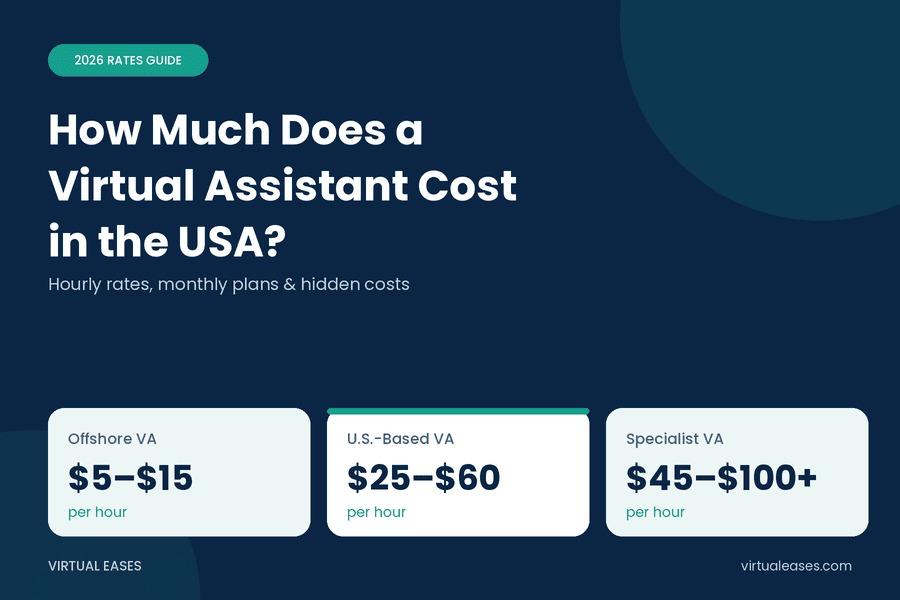
Virtual assistant cost in the USA typically runs from $5 to $15 per hour for offshore generalist VAs and $25 to $60 per hour for U.S.-based VAs. Specialized VAs, such as bookkeepers or executive assistants, often charge $30 to $100 or more per hour. Most small businesses spend a few hundred to a few thousand dollars a month, depending on how many hours they need.
This guide breaks down what drives those numbers, how pricing models differ, and how to estimate your own budget.
Virtual assistant rates at a glance
| VA type | Typical hourly rate | Best for |
| Offshore generalist | 5–15 | Email, scheduling, data entry, research |
| Offshore specialist | 10–30 | Bookkeeping, design, SEO, social media |
| U.S.-based generalist | 25–45 | Client-facing admin, phone support |
| U.S.-based specialist or executive VA | 45–100+ | Executive support, project management |
These are typical market ranges. Your rate depends on the factors below.
4 common virtual assistant pricing models
Hourly. You pay for the hours worked. This is flexible, but costs can drift if tasks aren’t scoped.
Monthly hour packages. You buy a block of hours, such as 10, 40, 80, or 160, at a set rate. Larger blocks usually lower the hourly price. This is the most common model for small businesses.
Monthly retainer. A flat fee covers a defined scope of work, such as inbox management and calendar upkeep.
Project-based. A fixed price for one deliverable, such as a lead list, a website update, or a bookkeeping cleanup.
What affects virtual assistant cost?
- Location. U.S.-based VAs cost more than offshore VAs because of local wage levels.
- Skill level. Basic admin work costs less than bookkeeping, SEO, or executive support.
- Experience. Someone who has run a founder’s calendar for years charges more than a first-year VA.
- Hours committed. Bigger monthly commitments usually get lower rates.
- Tools and software. Some providers include project tools. Others bill them separately.
- Management model. Working with an agency costs more per hour than a freelancer, but it adds backup coverage, vetting, and replacement support.
Virtual assistant vs. in-house assistant: cost comparison
An in-house assistant costs more than the salary figure suggests. BLS data from May 2025 puts the median pay for administrative assistants at $47,540 per year, and executive assistants at $76,590. On top of that, you pay payroll taxes, benefits, equipment, software seats, and paid time off. wagedexwagedex
A VA is usually a contractor, so you pay for productive hours only. For part-time or fluctuating workloads, that’s often the cheaper route. For a full-time role that needs on-site presence, an employee may be the better fit.
Hidden costs to check before you sign
- Minimum monthly commitments or setup fees
- Overtime or rush rates
- Whether unused hours roll over
- Tool subscriptions (project management, password manager, time tracking)
- Replacement terms if your VA leaves
- Notice period to cancel or change plans
How to estimate your virtual assistant budget
Use this formula: hours per week × 4.3 × hourly rate = monthly cost.
Example: 10 hours per week × 4.3 = about 43 hours a month. At $12 an hour, that’s roughly $516 per month. At $40 an hour, it’s about $1,720.
To size the hours, track your own week for five days. Note every task that is repetitive, rule-based, or doesn’t need your judgment. That list is your delegation pool.
Is hiring a virtual assistant worth it?
Compare the VA’s rate to the value of your own time. If you bill $75 an hour and delegate 8 hours a week of admin work at $12 an hour, you free up time worth about $600 for a cost of about $96. The math only works if you use the reclaimed time on revenue work or rest.
How Virtual Eases pricing works
Virtual Eases offers plans of 10, 40, 80, and 160 hours. In practice, that’s about 2.5 hours a week up to a full-time schedule. [Insert your actual rate per plan, what’s included (tools, supervision, replacement policy), and any minimums.] See current Virtual Eases pricing plans or talk to our team for a custom quote.
FAQ
How much does a virtual assistant cost per hour in the USA?
Offshore virtual assistants typically charge $5 to $15 per hour. U.S.-based VAs usually charge $25 to $60. Specialized roles like bookkeeping or executive support can exceed $100 per hour.
How much does a virtual assistant cost per month?
It depends on hours. Ten hours a week at $12 per hour is about $500 per month. A full-time offshore VA at 160 hours a month costs more, and U.S.-based full-time support costs significantly more.
Is a virtual assistant cheaper than an employee?
Often, yes, for part-time or variable work. You don’t pay benefits, payroll taxes, equipment, or paid time off, and you pay only for hours worked.
Why do virtual assistant rates vary so much?
Rates reflect location, skill level, experience, hours committed, and whether you hire through an agency or a freelancer. Specialized skills command higher prices.
Can I hire a virtual assistant for just 10 hours a month?
Yes. Many providers offer small hour packages for light support such as inbox cleanup or scheduling. Check for minimums and whether unused hours roll over.