As your agency grows, staffing becomes one of your biggest financial decisions. Should you hire an in-house transaction coordinator or administrative assistant? Or should you outsource to a virtual professional?
This real estate virtual assistant cost comparison will help you evaluate the true financial impact of both options. Beyond salary alone, you must account for taxes, benefits, overhead, turnover, and scalability.
If you’re assessing VA vs in-house assistant cost, this guide provides a clear, data-driven breakdown so you can make a confident investment decision.
Understanding Real Estate Staffing Cost: The Full Financial Picture
Many brokers underestimate the total cost of hiring. Salary is just one piece of the puzzle.
When evaluating real estate staffing cost, you must calculate:
- Base salary
- Employer payroll taxes
- Health insurance and benefits
- Office space
- Equipment and software
- Recruiting and training
- Turnover risk
Let’s break it down.
Cost Comparison: Virtual Assistant vs In-House Coordinator
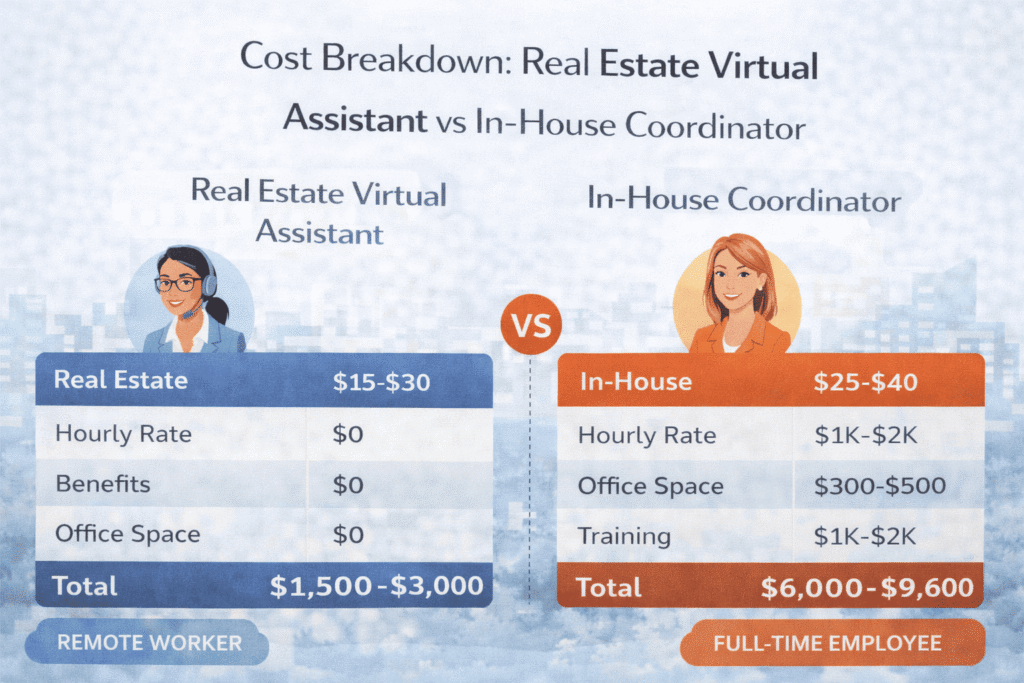
Below is a realistic annual cost estimate for a US-based real estate coordinator.
| Cost Category | In-House Coordinator (Annual) | Real Estate Virtual Assistant (Annual) |
| Base Salary | $50,000 | — |
| Payroll Taxes (7.65%+) | $3,825 | $0 |
| Health Benefits | $6,000 | $0 |
| Retirement Contributions | $2,000 | $0 |
| Office Space & Utilities | $8,000 | $0 |
| Equipment (Laptop, Desk, etc.) | $2,500 | $0 |
| Software Licenses | $1,500 | Often Included |
| Recruiting Costs | $4,000 | $0 |
| Training & Onboarding | $3,000 | Minimal |
| Turnover Risk (20–30%) | $10,000+ | Low |
| Estimated Total | $90,000+ per year | $12,000–$30,000 per year |
A virtual assistant typically works on a monthly retainer or hourly model. Even at $1,500–$2,500 per month, your annual investment ranges between $18,000–$30,000.
The difference is significant.
Real Estate Virtual Assistant Cost Comparison: What You Actually Save
When you switch from an in-house coordinator to a virtual assistant model, you eliminate:
- Employment taxes
- Benefits obligations
- Physical office overhead
- Long-term employment liability
- Paid time off and sick leave expenses
- Workers’ compensation insurance
Instead, you pay for productivity—not presence.
That distinction changes your financial structure from fixed overhead to scalable operational expense.
ROI Breakdown: A Practical Example
Let’s assume:
- You pay an in-house coordinator $90,000 per year total cost.
- You hire a virtual assistant for $24,000 annually.
- Your annual savings = $66,000.
Now, consider opportunity cost.
If your virtual assistant frees up 10 hours per week, that’s 520 hours per year.
If those hours allow you to close just 4 additional transactions annually at $10,000 average commission:
4 × $10,000 = $40,000 additional revenue.
Combined financial impact:
- $66,000 cost savings
- $40,000 additional revenue
- Total financial advantage: $106,000 annually
That’s a substantial ROI shift.
Pros & Cons: Virtual Assistant vs In-House Coordinator
In-House Coordinator
Pros
- Physical presence in office
- Immediate in-person communication
- Direct supervision
Cons
- High fixed overhead
- Payroll liability
- Limited scalability
- Turnover risk
- Paid downtime
Real Estate Virtual Assistant
Pros
- Lower overall real estate staffing cost
- Flexible monthly structure
- Scalable hours
- No payroll taxes
- Reduced HR management
- Performance-based engagement
Cons
- Remote communication required
- Initial onboarding period
- Requires clear SOPs
For growing agencies, flexibility often outweighs physical presence.
Scalability: The Financial Advantage Most Agencies Overlook
Growth rarely happens in a straight line. Your listing volume may spike in Q2 and Q3, then slow in Q4.
With an in-house employee:
- You pay the same salary during slow months.
- Reducing staff means severance risk.
- Expanding requires another full hire.
With a virtual assistant:
- Increase hours during peak season.
- Reduce support during slower cycles.
- Add specialized support (marketing, CRM, transaction coordination) without adding payroll liability.
This elasticity gives your agency operational agility.
In financial terms, that reduces risk exposure.
Addressing Common Objections
“I need someone physically in the office.”
Most real estate coordination tasks are cloud-based. MLS platforms, CRMs, email, and transaction software are online. Physical presence rarely increases productivity.
“What about data security?”
Professional VAs use secure password managers, encrypted systems, and NDA agreements. Security risk is often equal to—or lower than—in-house setups.
“Won’t communication be slower?”
With structured processes and project management tools, communication can actually become more efficient and documented.
“What if they leave?”
Turnover costs for in-house hires can exceed $10,000–$15,000. Many virtual assistant agencies offer continuity support or replacement guarantees.
When an In-House Coordinator Makes Sense
There are cases where internal hires are appropriate:
- You run a large brokerage with heavy walk-in traffic.
- You require daily physical file handling.
- You manage multiple on-site administrative roles.
However, for most growing teams evaluating VA vs in-house assistant cost, the numbers favor outsourced support—especially under 150 annual transactions.
Strategic Financial Perspective
In 2026 and beyond, smart agencies are shifting from fixed overhead models to variable cost structures.
Why?
Because:
- Margins are tightening.
- Marketing costs are increasing.
- Technology expenses are growing.
- Competition is intensifying.
A flexible cost base protects your profitability.
The real estate virtual assistant cost comparison isn’t just about saving money—it’s about improving operational leverage.
Conclusion: Make a Financially Smart Staffing Decision
If you’re evaluating staffing options, focus on total financial impact—not just salary.
An in-house coordinator can exceed $90,000 annually when fully burdened. A virtual assistant model often costs 60–75% less while offering greater flexibility.
This real estate virtual assistant cost comparison shows that outsourcing can:
- Lower fixed overhead
- Increase ROI
- Improve scalability
- Reduce turnover risk
- Strengthen profit margins
If your goal is to grow without inflating expenses, now is the time to evaluate a virtual assistant staffing model.
Take control of your real estate staffing cost—explore a scalable virtual assistant solution today.