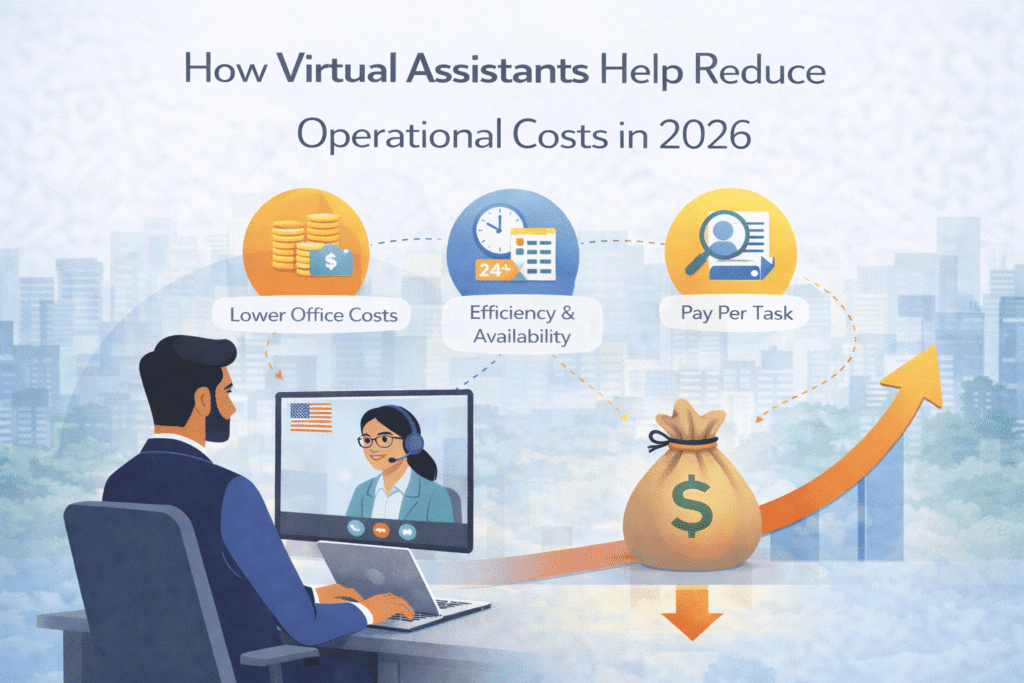
In 2026, business margins are tighter, competition is sharper, and operational efficiency is no longer optional—it’s strategic. Rising payroll expenses, office leases, software subscriptions, and compliance costs are forcing small and mid-sized businesses to rethink their cost structures.
If you’re looking for ways to reduce business costs with virtual assistant support, you’re not alone. More companies are shifting from fixed overhead models to flexible, outsourced support structures.
This isn’t just about cutting expenses. It’s about building a leaner, smarter organization designed for long-term sustainability.
Let’s break down how virtual assistants create measurable financial impact.
1. Payroll Savings: Turning Fixed Salaries into Flexible Expenses
Payroll remains one of the largest operational expenses for growing businesses.
When you hire full-time staff, you commit to:
- Base salary
- Payroll taxes
- Health benefits
- Paid time off
- Insurance contributions
- Compliance requirements
In 2026, with increasing wage expectations and benefit costs, this burden continues to grow.
By contrast, outsourcing admin tasks through a virtual assistant allows you to:
- Pay only for hours worked
- Avoid employment taxes
- Eliminate benefit obligations
- Scale support up or down
This shift transforms labor from a fixed cost into a controllable variable expense.
2. Infrastructure Reduction: Lower Overhead, Higher Agility
Office space is expensive—even in hybrid work environments.
When you hire in-house employees, you absorb:
- Rent or mortgage costs
- Utilities
- Furniture
- Equipment
- Maintenance
Remote support savings eliminate most of these infrastructure requirements. A virtual assistant works from their own location with their own equipment.
That means:
- No additional desk space
- No hardware investment
- No utility increases
- No facility expansion during growth
You reduce capital expenditures while maintaining operational output.
3. Tool Consolidation: Streamlining Software Costs
Many businesses overspend on tools because workflows are fragmented.
When you bring in a skilled virtual assistant, they often:
- Optimize existing systems
- Eliminate redundant subscriptions
- Centralize communication platforms
- Improve CRM utilization
Instead of adding new tools, they help you use what you already pay for more effectively.
This creates indirect but meaningful remote support savings.
4. Productivity Increase: More Output Without More Headcount
Efficiency isn’t just about cost reduction—it’s about maximizing output.
When you handle administrative tasks yourself, you reduce time available for:
- Strategic planning
- Sales
- Business development
- Partnerships
By outsourcing admin tasks, you shift your focus to revenue-generating activities.
Research consistently shows that context switching and multitasking reduce productivity by up to 40%. Delegating operational tasks allows you to work in your zone of expertise.
The result: higher performance without increasing payroll.
5. Opportunity Cost Savings: The Hidden Financial Multiplier
Opportunity cost is often invisible—but powerful.
Every hour you spend on administrative work is an hour not spent growing revenue.
Let’s look at a simple example.
Scenario:
- You spend 12 hours per week on admin tasks.
- Your average revenue-generating hour produces $150 in value.
- That’s $1,800 in weekly opportunity cost.
If you hire a virtual assistant for $1,200 per month and recover 48 hours per month:
48 hours × $150 = $7,200 potential revenue capacity.
Even if you convert only 25% of that potential:
$1,800 in recovered revenue per month.
That’s a positive ROI while also lowering stress and overhead.
This is how you strategically reduce business costs with virtual assistant support—by protecting both expenses and growth potential.
Fixed vs Variable Cost Comparison
Understanding cost structure is critical for 2026 business strategy.
Fixed Costs (Traditional Model)
- Salaries
- Office rent
- Equipment leases
- Insurance
- Long-term contracts
These remain constant—even when revenue dips.
Variable Costs (Virtual Assistant Model)
- Hourly or monthly support fees
- Scalable service levels
- Project-based billing
You adjust spending based on actual business demand.
In uncertain economic cycles, variable models protect cash flow.
Why 2026 Is a Turning Point
Several trends are accelerating the shift toward remote support savings:
- Increased digital infrastructure
- Remote-first workforce expectations
- Automation and AI integration
- Rising compliance and payroll costs
- Global talent accessibility
Businesses that adapt early gain a structural advantage.
The goal isn’t just to cut costs—it’s to build operational resilience.
Strategic Implementation Tips
If you’re considering outsourcing admin tasks, start with:
- Email and calendar management
- Data entry
- Customer support coordination
- CRM updates
- Research tasks
Measure:
- Hours saved
- Revenue impact
- Error reduction
- Cost reduction
Treat delegation as a performance strategy—not just an expense decision.
Conclusion: Build a Leaner Business Model in 2026
To reduce business costs with virtual assistant support in 2026, you must think beyond payroll alone.
Virtual assistants help you:
- Lower fixed overhead
- Reduce infrastructure expenses
- Optimize tools
- Improve productivity
- Recover opportunity cost
The result is a leaner, more adaptable organization positioned for sustainable growth.
If you want to protect margins while increasing capacity, the next step is clear.
Explore virtual assistant support and start building a smarter cost structure today.