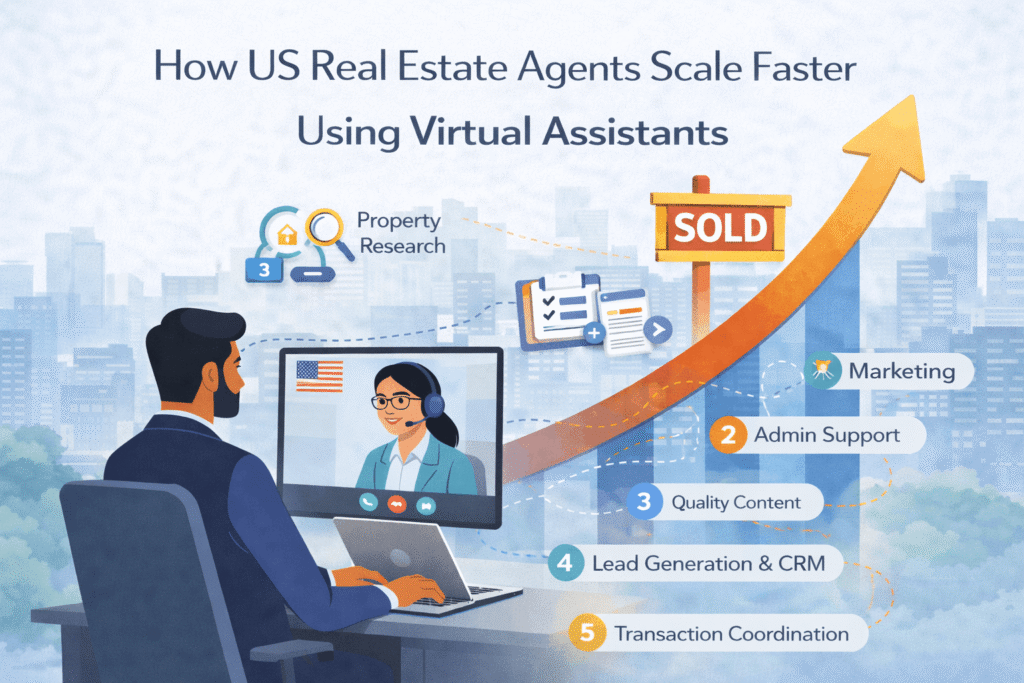
Scaling a real estate business in the United States is not just about generating more leads. It is about building systems, maintaining consistency, and protecting the agent’s time. Many US real estate agents reach a point where demand increases, but growth stalls because operations cannot keep up.
This is where Virtual Assistants (VAs) play a critical role.
High-growth real estate agents do not scale by working longer hours. They scale by delegating the right tasks to the right support. Virtual assistants help agents handle more leads, close more deals, and expand their business without increasing stress or overhead.
This article explains exactly how US real estate agents scale faster using virtual assistants, what tasks are delegated, and why VAs have become a key growth lever in modern real estate teams.
The Scaling Problem Most US Real Estate Agents Face
Most agents start as solo operators. In the early stages, doing everything themselves feels manageable. Over time, however, success creates complexity.
Agents begin to struggle with:
- Managing growing lead volumes
- Responding quickly to inquiries
- Following up consistently
- Handling listings and transactions
- Managing marketing and CRM systems
At this stage, growth slows not because of lack of demand, but because of lack of operational capacity.
Virtual assistants solve this problem by allowing agents to scale operations without scaling chaos.
What Is a Real Estate Virtual Assistant?
A Real Estate Virtual Assistant is a remote professional trained to support real estate workflows. Unlike general assistants, real estate VAs understand industry-specific tools, processes, and communication standards used by US agents.
They work remotely but integrate directly into:
- CRMs
- Transaction platforms
- Marketing systems
- Lead management workflows
This allows agents to delegate operational tasks while remaining focused on revenue-generating activities.
Why Virtual Assistants Are a Scaling Advantage for US Agents
Scaling requires leverage. Virtual assistants provide leverage in three critical ways:
- Time leverage – freeing agents from low-value tasks
- Cost leverage – reducing overhead compared to in-house staff
- Process leverage – enabling repeatable systems that scale
Agents who use VAs can handle more leads, more listings, and more transactions without increasing personal workload.
How Virtual Assistants Help Real Estate Agents Scale Faster
Below are the core areas where virtual assistants directly impact growth and scalability.
1. Faster Lead Response and Follow-Up
Speed-to-lead is one of the most important conversion factors in real estate. High-performing agents respond within minutes, not hours.
VA Support Includes:
- Immediate responses to new inquiries
- Automated SMS and email follow-ups
- Scheduled follow-up sequences
- CRM updates after each interaction
Scaling Impact:
Agents no longer miss opportunities due to delayed responses. Faster follow-ups lead to higher engagement and more appointments without requiring agents to be available 24/7.
2. Lead Management and CRM Organization
As lead volume grows, manual tracking becomes ineffective. Disorganized CRMs result in lost prospects and poor conversion tracking.
VA Responsibilities:
- Importing and tagging leads
- Segmenting buyers, sellers, and investors
- Updating lead status and notes
- Assigning leads to agents
- Maintaining clean CRM data
Scaling Impact:
With structured CRM management, agents can scale lead generation while maintaining visibility and control.
3. Lead Qualification and Prioritization
Not all leads are ready to buy or sell immediately. Spending time on unqualified leads slows growth.
VA Qualification Tasks:
- Asking pre-screening questions
- Identifying timelines and budgets
- Tagging leads by intent level
- Escalating high-quality prospects
Scaling Impact:
Agents focus on high-intent leads, increasing conversion rates and reducing wasted effort.
4. Appointment Setting and Calendar Management
As volume increases, managing appointments becomes time-consuming and error-prone.
VA Scheduling Support:
- Booking buyer and seller consultations
- Managing showing schedules
- Sending confirmations and reminders
- Handling reschedules and cancellations
Scaling Impact:
Agents maintain full calendars without administrative distractions, allowing them to handle more clients efficiently.
5. Listing Management and MLS Support
More listings mean more operational work. Each listing requires coordination across platforms and stakeholders.
VA Listing Tasks:
- Creating and updating MLS listings
- Uploading photos and property descriptions
- Managing price changes and status updates
- Syndicating listings to third-party platforms
Scaling Impact:
Agents can take on more listings without being buried in administrative work.
6. Transaction Coordination and Deal Management
As deal volume grows, transaction complexity increases. Missing deadlines or documents can slow closings and damage client trust.
VA Transaction Support Includes:
- Managing transaction checklists
- Uploading contracts and disclosures
- Tracking deadlines and contingencies
- Coordinating with lenders, escrow, and title
Scaling Impact:
Transactions move smoothly, allowing agents to close more deals simultaneously.
7. Marketing Execution and Content Management
Marketing consistency is essential for long-term growth, but execution often falls behind as agents get busy.
VA Marketing Tasks:
- Scheduling social media posts
- Sending email newsletters
- Uploading blog content
- Managing property marketing assets
- Supporting ad campaign execution
Scaling Impact:
Agents maintain visibility and brand presence while focusing on sales activities.
8. Data Tracking and Performance Reporting
Scaling requires insight. High-growth agents rely on data to optimize performance.
VA Reporting Support:
- Lead source performance tracking
- Conversion rate reporting
- Appointment and closing metrics
- Follow-up effectiveness analysis
Scaling Impact:
Agents make informed decisions that improve ROI and operational efficiency.
How Virtual Assistants Help Agents Scale Without Burnout
Burnout is one of the biggest threats to sustainable growth. Many agents work longer hours instead of working smarter.
Virtual assistants:
- Reduce mental overload
- Create predictable workflows
- Eliminate repetitive tasks
- Improve work-life balance
Agents who delegate early scale faster and last longer in the business.
Why Virtual Assistants Are More Scalable Than In-House Hiring
Hiring in-house staff comes with limitations:
- High salary and benefits costs
- Office space requirements
- Fixed schedules
- Long hiring cycles
Virtual assistants offer:
- Lower operational costs
- Flexible hours
- Faster onboarding
- Easier scalability as demand grows
This makes VAs ideal for agents looking to grow without heavy commitments.
Common Tasks High-Growth Agents Delegate First
Agents who scale successfully typically start by delegating:
- CRM management
- Lead follow-ups
- Appointment scheduling
- Listing uploads
- Transaction coordination
These tasks deliver immediate time savings and operational relief.
When Should a Real Estate Agent Hire a Virtual Assistant?
You should consider hiring a VA if:
- You are missing follow-ups
- Lead volume is increasing
- Admin work consumes most of your day
- You want to grow but feel stretched
- Your systems are breaking under scale
The best time to hire a VA is before you feel overwhelmed.
How VirtualEases Helps US Real Estate Agents Scale Faster
VirtualEases provides trained real estate virtual assistants who understand the US market. Our VAs are experienced in:
- US real estate CRMs
- Lead generation and follow-up systems
- Transaction and listing processes
- Professional client communication
- Team-based workflows
We focus on long-term support, not just task completion.
The Key Takeaway
Scaling in real estate is not about doing more yourself. It is about building systems that allow growth without loss of quality.
Virtual assistants enable US real estate agents to:
- Respond faster
- Close more deals
- Maintain consistency
- Reduce burnout
- Scale sustainably
Agents who leverage VAs gain a competitive advantage in a crowded market.