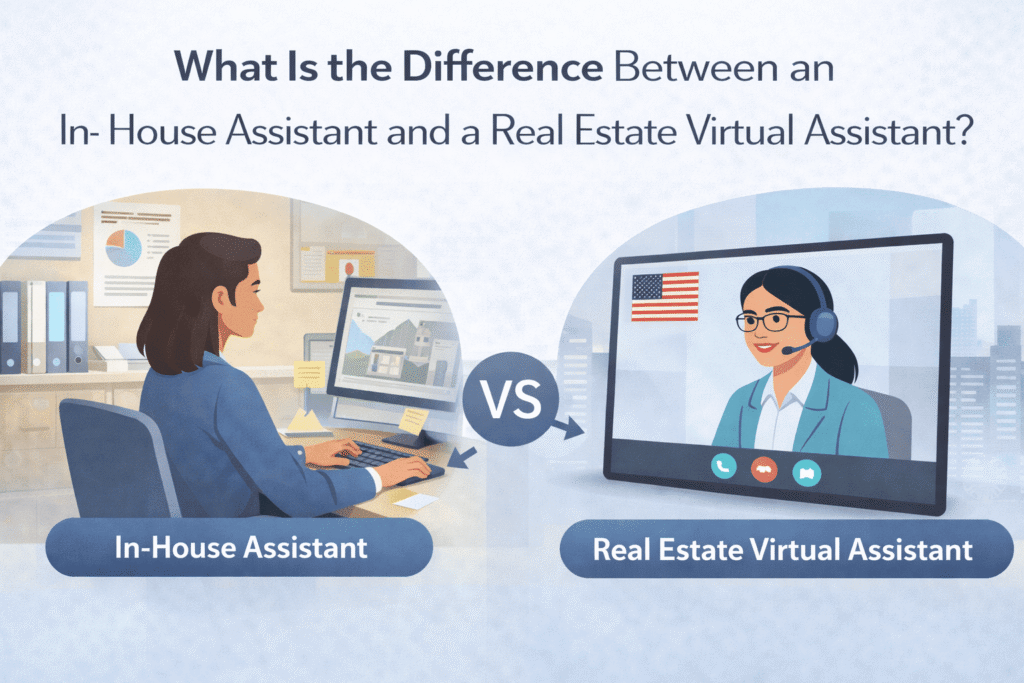
As real estate businesses in the USA continue to scale, one strategic decision consistently shapes productivity and profitability: how administrative and operational support is structured.
Should you hire an in-house assistant who works from your office, or should you partner with a real estate virtual assistant (VA) who supports your business remotely?
This decision impacts not just costs, but also efficiency, flexibility, compliance, and long-term growth. This guide breaks down the real differences that actually matter to US real estate agents, teams, and brokerages, so you can choose the model that aligns with your goals.
Understanding the Two Support Models in Real Estate Operations
Rather than repeating definitions, it’s more useful to understand how each model functions in real-world real estate environments.
An in-house assistant is embedded physically within your office setup, often handling a mix of administrative and client-facing tasks.
A real estate virtual assistant operates remotely, supporting your business through digital systems, processes, and communication tools—often on flexible schedules.
The difference is not about location alone, it’s about operational design.
Cost Structure: Fixed Overhead vs Flexible Investment
In-House Assistant Cost Reality
Hiring an in-house assistant in the US involves:
- Salary or hourly wages
- Payroll taxes
- Health benefits
- Paid leave
- Office space and equipment
- Training and onboarding costs
These are fixed expenses, regardless of workload.
Real Estate Virtual Assistant Cost Model
Virtual assistants typically involve:
- Hourly or monthly service fees
- No payroll tax obligations
- No benefits or office costs
- Scalable hours based on demand
This makes VAs a variable operational cost, ideal for fluctuating real estate cycles.
Scalability During Market Changes
In-House Teams and Market Volatility
Real estate markets are cyclical. During slow seasons:
- In-house staff may be underutilized
- Payroll costs remain constant
- Downsizing impacts morale and reputation
Virtual Assistants and Growth Flexibility
With VAs, you can:
- Increase hours during peak seasons
- Reduce scope during slower periods
- Add specialized support without rehiring
This agility is critical in fast-changing US housing markets.
Task Coverage and Specialization
In-House Assistants: Generalists by Design
Most in-house assistants:
- Handle multiple unrelated tasks
- Learn on the job
- Support one agent or team
Depth in specialized tools may be limited.
Virtual Assistants: Process-Driven Specialists
Real estate VAs are often trained specifically in:
- CRM systems
- MLS data handling
- Transaction coordination platforms
- Lead management workflows
- Digital marketing tools
This specialization improves speed, consistency, and accuracy.
Productivity and Focus
Office Interruptions vs Remote Efficiency
In-house assistants:
- Face frequent interruptions
- Are pulled into ad-hoc tasks
- May split attention across teams
Virtual assistants:
- Work from defined SOPs
- Focus on assigned deliverables
- Follow time-tracked workflows
This structure often leads to higher output per hour.
Compliance, Risk, and Accountability
In-House Employment Risk
Employers must manage:
- HR compliance
- Workplace policies
- Termination risks
- Labor law exposure
Virtual Assistant Risk Management
VA services often include:
- Service agreements
- NDAs
- Performance SLAs
- Replacement guarantees
This shifts operational risk away from the agent or brokerage.
Technology & Tool Adoption
In-House Assistants and Learning Curves
In-office staff may require:
- Tool-specific training
- Longer onboarding
- Ongoing supervision
Virtual Assistants and System Familiarity
Most real estate VAs already work with:
- CRMs (Follow Up Boss, kvCORE, Salesforce)
- Transaction platforms
- Email marketing systems
- Scheduling and automation tools
This reduces ramp-up time significantly.
Availability and Time Zone Advantages
In-House Availability Limits
In-house assistants typically:
- Work standard office hours
- Take local holidays
- Are unavailable after hours
Virtual Assistant Coverage Options
VAs can:
- Work in US time zones
- Offer extended or split-hour coverage
- Support weekend or evening operations
This improves lead response times and client satisfaction.
Business Continuity & Backup Support
In-House Dependency Risk
If an in-house assistant:
- Takes leave
- Resigns
- Falls sick
Operations slow down immediately.
Virtual Assistant Continuity
VA providers often:
- Maintain backup resources
- Offer quick replacements
- Ensure continuity of service
This reduces operational downtime.
Cultural Integration and Team Dynamics
In-House Team Culture
In-office assistants:
- Participate in daily interactions
- Build local relationships
- Require cultural alignment
Virtual Collaboration Culture
With VAs:
- Communication is process-based
- Documentation replaces verbal dependency
- Performance is measured by output
This encourages system-driven growth, not personality-driven dependency.
Control vs Outcome Management
In-House Management Style
Managers often focus on:
- Attendance
- Activity monitoring
- Presence
Virtual Assistant Management Style
VA management focuses on:
- Deliverables
- KPIs
- Turnaround time
- Quality benchmarks
This shifts focus from hours worked to results achieved.
Long-Term Growth Strategy Fit
In-House Model Works Best When:
- You have consistent, high workload
- You need daily in-office support
- You operate at stable scale
Virtual Assistant Model Works Best When:
- You want lean operations
- You aim to scale quickly
- You want predictable costs
- You value process efficiency
FAQs
1. Is a virtual assistant legally allowed to support US real estate agents?
Yes, as long as licensed activities remain with the agent.
2. Can a virtual assistant replace an in-house assistant completely?
In many operational roles, yes—except in-person duties.
3. Which option is better for solo agents?
Virtual assistants are usually more cost-effective for solo agents.
4. Do virtual assistants understand US real estate systems?
Professional VAs are trained specifically for US real estate workflows.
5. What about data security with VAs?
Reputable providers follow NDAs and secure access protocols.
6. Can I combine both models?
Yes, many teams use hybrid setups for optimal results.
7. How quickly can I switch from in-house to VA support?
Transition can be completed in 1–2 weeks with proper SOPs.
8. Are virtual assistants available full-time?
Yes, full-time and part-time options are available.
9. Is communication harder with virtual assistants?
With proper tools, communication is often more structured and efficient.
10. Which model delivers better ROI?
Most real estate businesses report higher ROI with virtual assistants.